Is It in My Genes? Understanding Hereditary Breast Cancer
The Question Many Families Quietly Carry
Many families notice a pattern. A mother, an aunt, a cousin. You may wonder if it's a coincidence. You may wonder if it could affect you. You may not want to ask, because the worry feels heavy.
These questions are common, and they are reasonable. Wanting to know more about your family's health is a caring thing to do. It is also a practical one. Information gives you choices.
Hereditary vs. Sporadic: What’s the Difference?
Most breast cancers are sporadic. This means they happen by chance, or from factors like age and hormones. They are not passed down in families.
Some breast cancers are hereditary. Research suggests roughly 5–10% are linked to inherited changes in our genes [1][2].
Let's define a few terms:
- Gene: a small section of your DNA. It holds instructions for how your body works.
- Variant: a change in a gene. Some variants are harmless. Some can raise the chance of certain cancers.
- Hereditary: passed from parent to child through genes.
You may have heard the word “mutation.” Many experts now say “variant,” because it sounds less alarming and is more accurate. Having a variant does not mean you will get cancer. It means your chance may be higher than average.
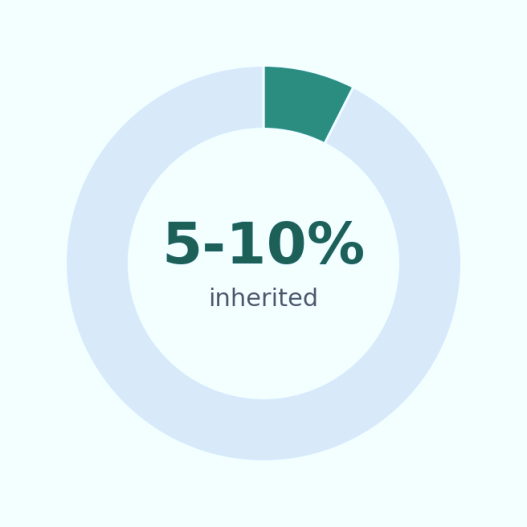
Where breast cancers come from: about 5–10% are linked to inherited variants. The rest are linked to other causes, including age, hormones, and chance.
What a Hereditary Cancer Panel Actually Is
A hereditary cancer panel is one test that looks at many genes at once.
Years ago, testing often checked only one or two genes, such as BRCA1 and BRCA2. Today, a panel can check many genes in a single test. That saves time and gives a fuller picture [6][7].
Here is how it works:
- You give a sample. This is a small blood or saliva sample.
- A lab reads your genes. Specialists look for variants linked to higher cancer risk.
- A genetic counselor explains the results. This is a health professional trained to help you understand genetics.
- You make a plan. Together with your care team, you decide on next steps.
| Step 1 | Step 2 | Step 3 | Step 4 |
|---|---|---|---|
| Sample Blood or saliva |
Lab Genes are read |
Genetic counselor Explains results |
Your plan Next steps together |
The Hereditary Cancer Panel at Greenarray
Greenarray offers a hereditary cancer panel that looks at genes linked to inherited risk for these cancers:
- Breast
- Ovarian
- Colon
- Endometrial (the lining of the uterus)
- Pancreatic
- Thyroid
- Gastric (stomach)
Why test for several cancers at once? Because some genes affect more than one type. Breast, ovarian, and colon cancers can sometimes connect through shared genes. One test can look across all of them [8].
This kind of testing is most useful when it is paired with counseling. The result is only part of the story. Your family history, age, and health matter too [4].
What a Panel Can Do
- Show whether you carry a variant linked to higher cancer risk
- Help your doctor plan screening that fits you, such as earlier or more frequent check-ups [3][4]
- Open the door to preventive options you can discuss with your care team
- Give your relatives useful information, so they can decide whether to be tested
A negative result is not a guarantee. Most cancers are not hereditary, and some genetic causes are not yet known. You and your doctor will still look at your family history and follow regular screening.
Sometimes a result is a “variant of uncertain significance.” This means scientists don't yet know what that change does. It is not a diagnosis. A genetic counselor can explain what it means for you and what, if anything, to do next [3][9].
Takeaway: Information, Not a Verdict
Genetic testing doesn't decide your future. It gives you information, and information can help you:
- Catch problems earlier
- Make choices that feel right for you
- Support the people you love
You don't have to figure this out alone. If cancer runs in your family, talk to your doctor or a genetic counselor. Ask whether a hereditary cancer panel could be right for you [5]. There is no wrong time to begin the conversation.
Explore Cancer Genomics at Greenarray Labs.
References
- American Cancer Society. Breast Cancer Risk Factors You Cannot Change (hereditary and genetic factors). cancer.org
- National Cancer Institute. BRCA Gene Changes: Cancer Risk and Genetic Testing. cancer.gov/about-cancer/causes-prevention/genetics/brca-fact-sheet
- Centers for Disease Control and Prevention. Genetic Testing for Hereditary Breast and Ovarian Cancer. cdc.gov/breast-ovarian-cancer-hereditary/testing/
- Centers for Disease Control and Prevention. CDC Grand Rounds: Family History and Genomics as Tools for Cancer Prevention and Control. MMWR Morb Mortal Wkly Rep. 2016;65(46). cdc.gov/mmwr/volumes/65/wr/mm6546a3.htm
- US Preventive Services Task Force. Risk Assessment, Genetic Counseling, and Genetic Testing for BRCA-Related Cancer: Recommendation Statement. JAMA. 2019;322(7). uspreventiveservicestaskforce.org
- Hu C, Hart SN, Gnanaolivu R, et al. A Population-Based Study of Genes Previously Implicated in Breast Cancer. N Engl J Med. 2021;384:440-451.
- Breast Cancer Association Consortium. Breast Cancer Risk Genes — Association Analysis in More than 113,000 Women. N Engl J Med. 2021;384:428-439.
- Society of Gynecologic Oncology. Facts about Lynch Syndrome. sgo.org/patient-resources/uterine-cancer/uterine-cancer-lynch-syndrome
- Richards S, Aziz N, Bale S, et al. Standards and Guidelines for the Interpretation of Sequence Variants (ACMG/AMP). Genet Med. 2015;17(5):405-424.